
Exporting from India requires proper compliance and accurate paperwork. Missing or incorrect documents can lead to shipment delays, customs penalties, or payment issues. This Export Documentation Checklist for Indian Exporters will help you understand every mandatory document required for exporting goods from India in 2026.
Whether you export ceramics (HSN 6907), spices, textiles, engineering goods, or food products — documentation is the backbone of smooth international trade.
Why Export Documentation Is Important
Proper export documentation ensures:
- Smooth customs clearance
- Faster shipment processing
- Secure international payments
- Eligibility for government incentives
- Reduced risk of shipment rejection
Indian exporters must comply with regulations issued by customs authorities and export promotion bodies before shipping goods internationally.
1. Mandatory Registration Documents for Indian Exporters
Before exporting goods from India, you must complete these registrations:
1. Import Export Code (IEC)
The Import Export Code (IEC) is issued by the
Directorate General of Foreign Trade.
Without IEC:
- You cannot clear goods through customs
- You cannot receive foreign currency payments
IEC is a one-time registration and valid for a lifetime.
2. GST Registration
GST registration is mandatory for exporters in India.
Exporters can:
- Export under LUT (without paying IGST)
OR - Pay IGST and claim a refund later
GST compliance is necessary for claiming refunds and export benefits.
3. RCMC (Registration Cum Membership Certificate)
RCMC is required to claim export incentives under the Foreign Trade Policy.
Issued by export promotion councils such as:
- Federation of Indian Export Organisations
- Engineering Export Promotion Council of India
2. Core Shipping Documents Required for Export
These are the most important export shipping documents required for customs clearance.
1. Commercial Invoice
The commercial invoice is the primary export document.
It must include:
- Exporter & buyer details
- HS Code
- Product description
- Quantity and price
- Incoterms (FOB, CIF, EXW, etc.)
- Country of origin
Incorrect invoice details can lead to customs objections.
2. Packing List
The packing list contains:
- Number of cartons
- Net weight & gross weight
- Dimensions
- Packaging details
It must match the commercial invoice exactly.
3. Shipping Bill
The shipping bill is filed electronically through Indian Customs (ICEGATE portal).
It acts as:
- Legal proof of export
- Customs clearance authorization
Without a shipping bill, goods cannot leave India.
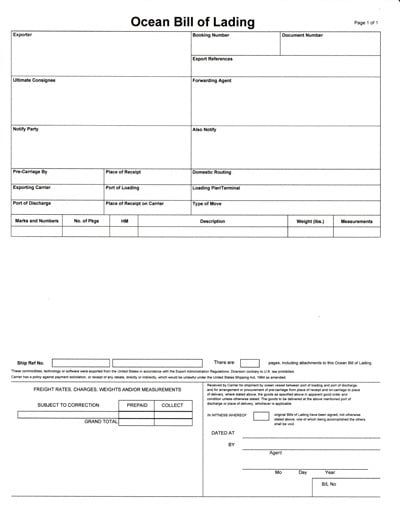
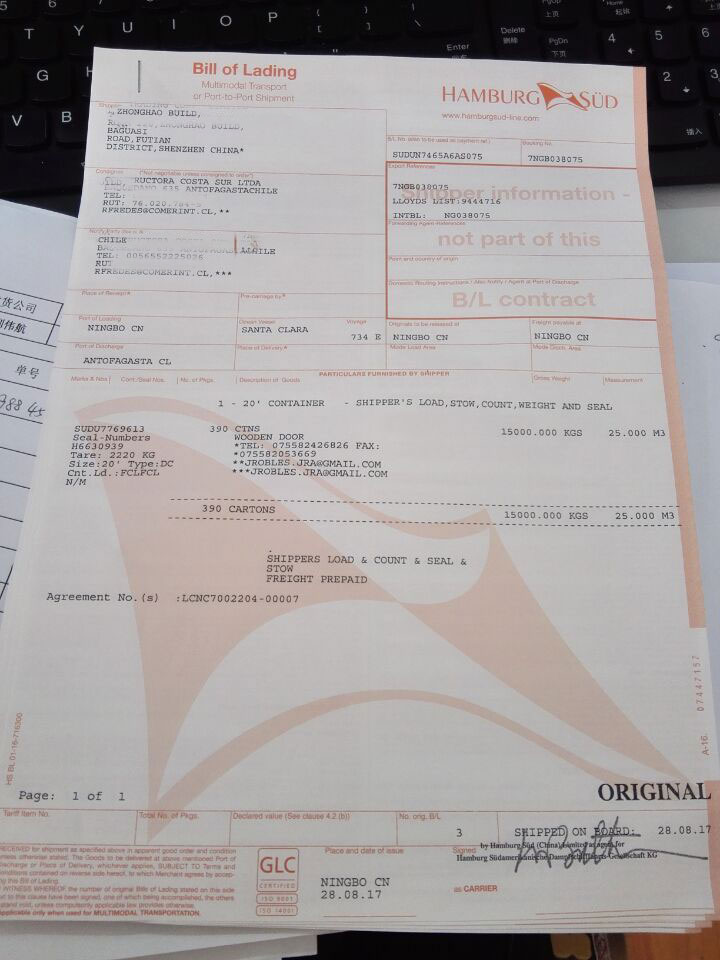
4. Bill of Lading (For Sea Shipment)

4
The Bill of Lading is issued by the shipping line and serves three purposes:
- Receipt of goods
- Contract of carriage
- Document of title
For air shipments, this document is replaced by an Airway Bill (AWB).
3. Product-Specific Export Documents
Certain products require additional certifications.
1. Certificate of Origin (COO)
The Certificate of Origin confirms that goods are manufactured in India.
It is issued by:
- Chamber of Commerce
- Export Promotion Councils
This document is necessary to claim duty benefits under Free Trade Agreements.
2. FSSAI License (For Food Exporters)
If you export food products, approval from
Food Safety and Standards Authority of India
is mandatory.
3. APEDA Registration (For Agricultural Exports)
Exporters dealing in agricultural and processed food products must register with
Agricultural and Processed Food Products Export Development Authority.
4. Phytosanitary Certificate
Required for:
- Agricultural goods
- Plant-based products
- Spices and grains
Issued by Plant Quarantine Authorities.
4. Banking and Payment Documents in Export
1. Letter of Credit (LC)
A Letter of Credit guarantees payment from the buyer’s bank.
Used mostly in high-value international trade transactions.
2. Bank Realisation Certificate (BRC)
The BRC confirms that export payment has been received in India.
It is required to:
- Claim export incentives
- Complete FEMA compliance
3. Insurance Certificate
Required in CIF shipments.
It protects goods from damage during transit.
5. Country-Specific Compliance Documents
Different countries may require:
- CE Certification (Europe)
- FDA Approval (USA)
- SASO Certification (Saudi Arabia)
- Halal Certification (Middle East)
Always confirm import requirements with your international buyer before shipment.
Complete Export Documentation Checklist (Quick Summary)
Before dispatching your shipment, ensure you have:
- IEC Code
- GST Registration
- RCMC
- Commercial Invoice
- Packing List
- Shipping Bill
- Bill of Lading / Airway Bill
- Certificate of Origin
- Product-specific certifications
- Insurance Certificate
- BRC (after payment)
Common Export Documentation Mistakes to Avoid
- Wrong HS Code declaration
- Mismatch in invoice and packing list
- Incorrect buyer details
- Wrong Incoterms
- Late shipping bill filing
Even minor errors can delay shipments at major Indian ports like Mumbai, Mundra, and Chennai.
Conclusion
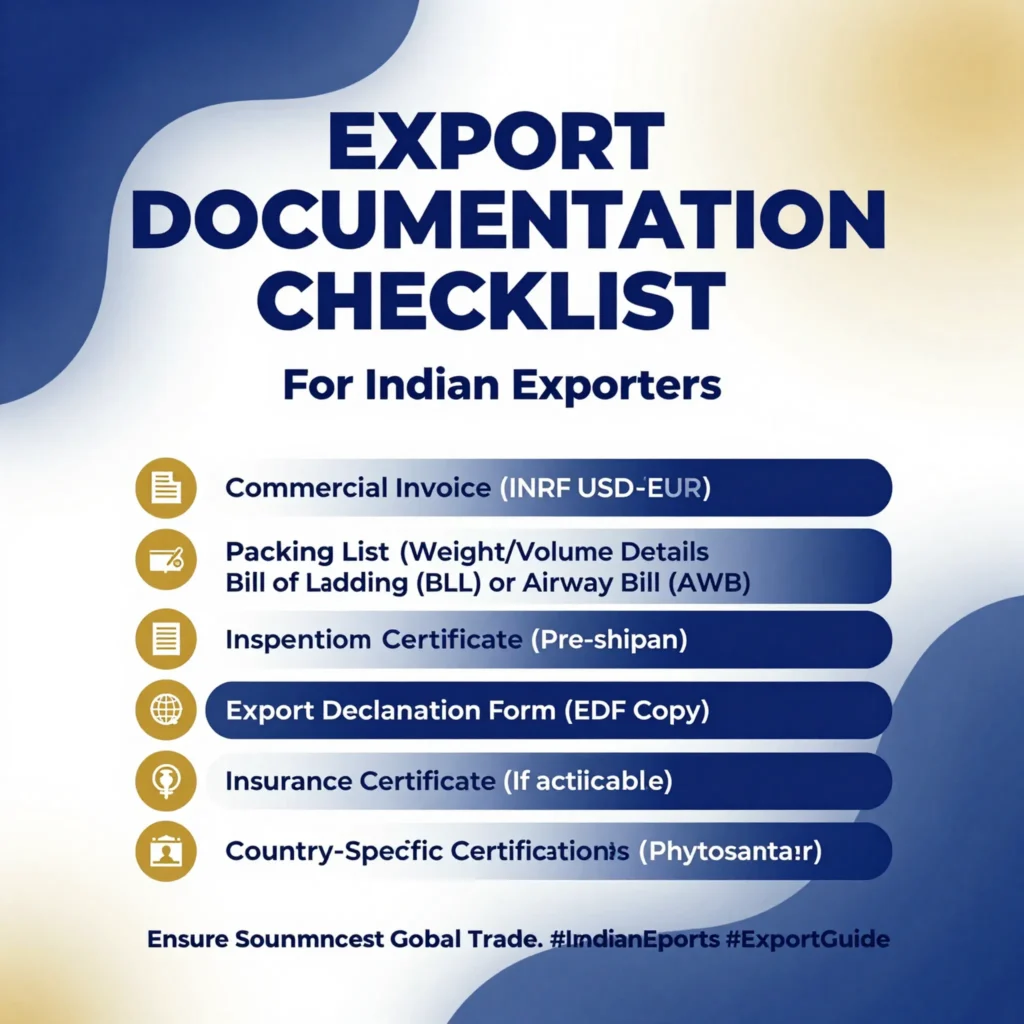
Export documentation is a critical part of international trade. Indian exporters must ensure that all mandatory documents are accurate and compliant to avoid shipment delays and payment risks. If you are planning to start exporting from India in 2026, preparing the right export documentation checklist in advance will help you scale smoothly in global markets. If you need structured assistance with documentation and buyer verification, explore our export support services to simplify your global trade journey